The flight simulator for any AI-powered machine.
Etalonis is where autonomous AI is trained, rehearsed and validated against a fixed reference standard — the étalon — before it ever runs on a real machine. A platform-agnostic digital-twin sandbox that runs thousands of scenarios a day, produces the proof, and delivers the certified software and edge-AI module that runs unchanged in the field. Built by Aimrika.
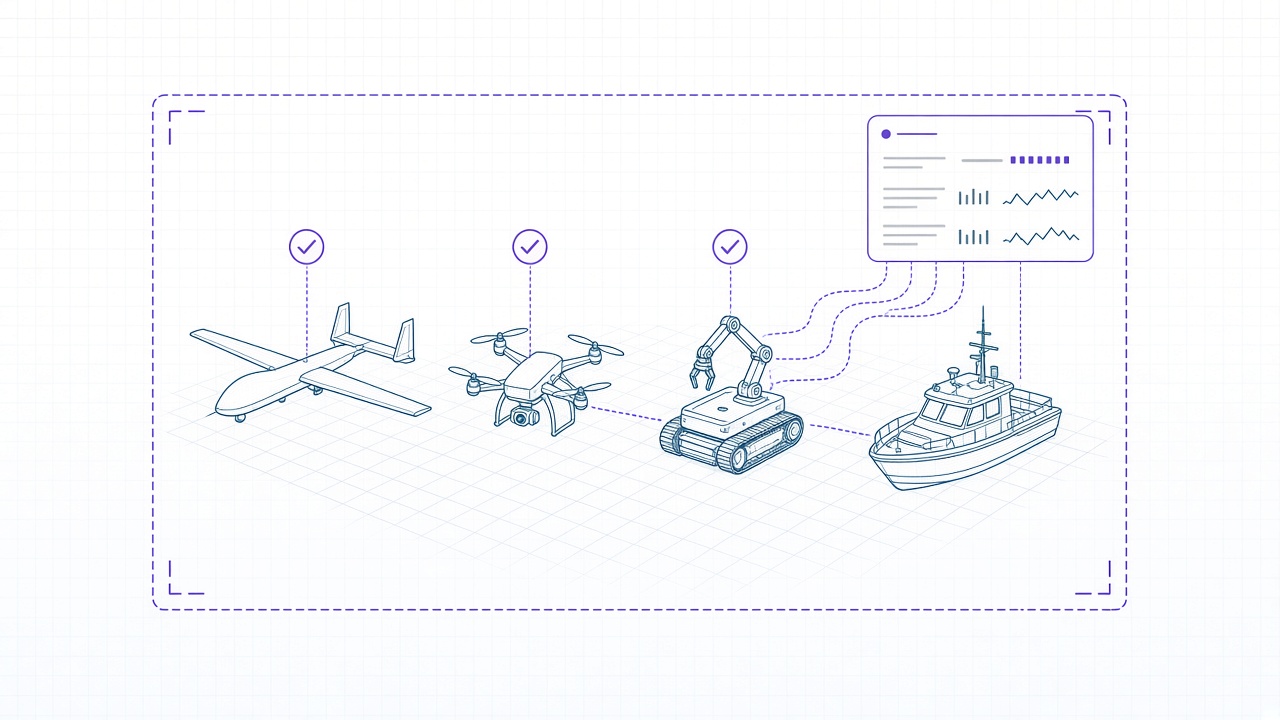
Robots can be built faster than they can be proven safe.
Real-world trials can't deliver the scale, safety or speed autonomy needs. The rare, critical conditions that matter most — the sensor failure, the degraded weather, the near-miss between two machines — are exactly the ones hardest and riskiest to test for real. You cannot crash your way to a dependable autonomous system.
01 Scale the real world can't provide
Physical AI needs millions of experiences across conditions no live programme can afford to reproduce — gravity, inertia, causality, failure.
02 Safety limits live testing
The behaviours that make a machine truly autonomous are the ones hardest, and most dangerous, to rehearse for real.
03 The edge cases are the point
The situations that matter most are exactly the ones you can least afford to stage in reality — so they go untested until they happen.
04 Proof, not just a demo
A system that looks good in one run isn't validated. Trust needs a fixed standard, applied every time, that a result can be measured and audited against.
Three things, in sequence — not just a simulator.
Etalonis doesn't stop at running a scenario. It produces the environment, the proof, and the certified thing you actually run in the field — in that order, every time.
The simulation & validation sandbox
A platform-agnostic digital-twin sandbox running thousands of realistic scenarios a day, available today. Every candidate change — a new sensor, a retrained model, a software update — runs here first, across weather, terrain, lighting, sensor noise and induced failures, at a scale no physical test programme can match.
A validation authority, not a demo
Every candidate is scored against a fixed reference standard — the étalon — on identical scenarios and identical physics. Because everything except who is acting is held constant, every difference in outcome is attributable to the agent alone. The result is comparable, reproducible and auditable. See the full method below.
The validated agent, and the machine
Etalonis produces the validated, deployment-ready software and the certified edge-AI compute module that runs it, unchanged, on the real machine. Flying vehicles today; ground and maritime robots next — carrying software that's already been proven, not guessed at.
Train → Rehearse → Coordinate → Validate → Deploy.
The same AI agent that passes Etalonis runs unchanged on the real edge hardware aboard the real machine. Real-world operation confirms the result; it does not discover it.
Train
The agent learns to perceive, navigate, act, recover and adapt across weather, terrain, lighting, sensor noise and induced failures.
Rehearse
The exact task — environment, route, objects, conditions — is run to standard in the sandbox. A true dry run, no risk, no cost.
Coordinate
Fleets of robots, drones and vehicles learn to operate as a team — the multi-agent rehearsal the real world can rarely afford.
Validate
Every behaviour is benchmarked against a reference system on identical scenarios and physics — the etalon.
Deploy
The validated agent runs on the real machine. Real-world operation confirms; it does not discover.
Prove, don't assert.
No capability is "done" until it beats a control, repeatably. Etalonis is named for this standard — the étalon, the reference against which everything is measured.
- What a reference system actually is. A mature reference implementation that performs the task under the same physics, the same scenario and the same conditions — the achievable ceiling the candidate agent is measured against.
- What "identical" means in practice. Identical digital-twin geometry, sensor models and physics parameters between the control run and the candidate run. Everything is held constant except who is acting, so any difference in outcome is attributable purely to the agent.
- What a validation result looks like. A scored comparison — task success, track/behaviour error relative to the control, degraded-condition recovery, and reproducibility across repeated runs — not a single cherry-picked run.
- Why this is an authority, not a demo. The same fixed standard is applied every time, to every candidate. That is what makes a result comparable, reproducible and auditable — the opposite of a one-off simulation staged to look good.
One licence. A thousand flights. Months, not minutes.
Under EU drone regulation (2019/947), a drone over 25kg — or flying beyond visual line of sight, above 120m, or over people — leaves the lightly-regulated "Open" category and needs a full risk assessment (SORA) and, at the top end, an EASA Design Verification Report or Type Certificate: a process comparable in scope to certifying a manned aircraft.
Getting an autonomous system to operate reliably — and safely alongside other autonomous systems, not just in isolation — plausibly needs on the order of a thousand times more validation iterations than a human operator would ever need. Flying a real 25kg+ drone a thousand times to prove one software change isn't just slow: for most operators, it isn't legally possible before the first flight has even cleared its own paperwork.
- Simulation isn't an optimisation of this process — it's the only way through it. Etalonis runs the equivalent of a thousand real flights, across weather, failure modes and multi-agent interactions, inside a digital twin, in minutes.
- The compliance evidence is a by-product, not a separate task. A validation run inside Etalonis generates exactly the evidence a SORA or Design Verification submission asks for.
The engineering foundation already exists.
Etalonis is not a concept — it is running infrastructure, proven first on a flying-vehicle platform, generalising to ground and maritime robots as the roadmap extends.
GPS-denied navigation
GPS can be denied, jammed or simply unavailable — indoors, in urban canyons, in contested environments. The agent localises itself from what it sees, not from satellite positioning, and this has been proven where positioning is denied, degraded or spoofed.
Fleets, not just one machine
Testing machines jointly — not just individually — is the harder and more realistic problem, and it is one that physical trials essentially cannot do at any useful scale. In simulation, fleets learn to coordinate safely before a single real deployment.
Measured, not hidden
One scoring harness runs both simulation and reality, so the gap between them is a number you track down over time — not a number you avoid publishing. Honesty by design: we never ship what we have not measured.
| Capability | What it means in practice |
|---|---|
| Visual Place Recognition (VPR) | The agent localises itself from what it sees, not from GPS — proven where satellite positioning is denied, degraded or spoofed. |
| Multi-agent rehearsal | Fleets of machines learn to coordinate — the joint-and-safe operation real-world trials can rarely afford to test at scale. |
| Sim-to-real gap, measured | One scoring harness runs both simulation and reality, so the gap between them is a measured number, not a hope. |
| Platform-agnostic | Built on a flying-vehicle platform first; the same environment, methodology and edge-compute architecture generalise to ground and maritime robots. |
The three computers of physical AI.
Physical AI stands on three computers: one to train the model, one to simulate the world, and one to run inference at the edge. Etalonis is the second — and we make it a validation authority.
Train
The AI is trained on commodity GPUs — the AI factory that turns data and experience into capability.
Simulate
The world model and sandbox where the agent lives thousands of lifetimes across digital twins — built and validated at a scale and speed the real world can't match. We add what general world models lack: a validation authority.
This is EtalonisInfer at the edge
The validated agent runs on an edge module aboard the real machine — perception to decision to action in real time, on-device, with no cloud and no operator.
One engine. Wherever autonomy must be trusted to act.
The same environment, methodology and edge-compute architecture apply across domains — each with its own validation problem that reality is slow, costly or unsafe to reproduce.
| Domain | The validation problem simulation solves |
|---|---|
| Inspection | Rehearse rare fault conditions and hard-to-reach geometry before sending a machine to find them for real. |
| Logistics | Prove reliable behaviour across the long tail of routes, loads and obstacles that a live fleet meets only occasionally. |
| Mobility | Stage the near-miss and the sensor failure safely, thousands of times, instead of waiting for them on the road. |
| Agriculture | Seasonal, weather-dependent conditions are expensive and slow to wait for in reality — simulate the season, not just the machine. |
| Mapping | Validate navigation and localisation across environments and lighting no single survey campaign could cover. |
| Maritime | Sea state, degraded visibility and GPS-denied navigation rehearsed before a vessel ever leaves port. |
| Energy | Inspect and operate around high-value, high-risk infrastructure where a real failed trial is not an option. |
| Search & rescue | Practise the exact conditions that matter most — the ones too rare and too dangerous to stage on demand. |
Illustrative of the validation problems Etalonis addresses across domains; not a claim of delivered projects in each vertical.
Proven first on flight. Built to generalise.
Proven first on a flying-vehicle platform. The same environment, methodology and edge-compute architecture are built to generalise to ground vehicles and maritime vessels as the product roadmap extends.
The company behind Etalonis.
Etalonis is built by Aimrika GmbH, founded by Volodymyr Levykin — founder of Skyrora, the British orbital-launch company. The conviction is the same: real capability, built honestly, proven before it ships.
Put Etalonis in front of your hardest validation problem.
For a technical briefing, a pilot, a partnership or an integration enquiry — reach out and tell us what you're trying to prove.